

Rhinoplasty, Fort Worth & Colleyville
A Fort Worth & Colleyville rhinoplasty specialist, Dr. Smith treats the airway with the same care as the silhouette: primary, revision, ethnic, and reconstructive cases.
Form, function, and a surgeon's proportion
At Precision Plastic Surgery, rhinoplasty is approached as both an aesthetic and a structural problem. The nose has to breathe before it can be beautiful, and it has to belong to the face it sits on.
Dr. Jesse E. Smith is double board-certified in Facial Plastic & Reconstructive Surgery and in Head & Neck Surgery. He has performed thousands of rhinoplasty procedures across the Fort Worth and Colleyville offices.
What is Rhinoplasty?
Rhinoplasty, sometimes called a “nose job,” is a surgical procedure to correct the form, the function, or both. The nose can be reshaped to fit more naturally with the rest of the face, and the airway can be opened where breathing has been obstructed.
The word comes from the Greek rhino, meaning of or relating to the nose, and plasty, meaning to form or shape. The procedure has been performed in some form for more than two thousand years; what has changed in the last decade is the precision with which the underlying structures can be preserved.
Preservation Rhinoplasty
The principle behind preservation rhinoplasty is to modify the nose while keeping as much native tissue as possible. Rather than reduce and rebuild, the surgeon repositions, using the patient’s own anatomy as the scaffolding for the result.
Done well, the dorsum is lowered without disrupting the smooth lines of the bridge; recovery is shorter, and the long-term result reads as the nose the patient was born with, only quieter.
Types of Rhinoplasty
Dr. Smith offers both surgical and non-surgical approaches. In practice the nose is treated in horizontal thirds, upper, middle, and lower, and each third has its own decisions. Common concerns include:
- A bulbous tip
- A crooked or misaligned nose
- A boxy tip
- A drooping tip
- A bump along the bridge
- Disproportionate or misshapen nostrils
Aesthetic and functional concerns are often resolved in the same operation, a deviated septum repaired alongside a refined silhouette, for example.
How the Procedure Works
Most rhinoplasties are performed under general anesthesia and take two to four hours, depending on what the patient is asking the surgeon to do. There are two surgical approaches:
Closed
All incisions are placed inside the nostrils. No external scar. Best suited to predictable, contained modifications.
Open
A small incision is added across the columella, the strip between the nostrils. Healed, the scar is essentially invisible. It provides the surgeon direct visualization for complex tip or revision work.
Rhinoplasty Cost
Rhinoplasty pricing in the Fort Worth and Colleyville area varies with the complexity of the case. After a consultation, the practice provides a written quote that includes surgeon’s fee, anesthesia, and facility charges.
Patients combining a functional septoplasty with cosmetic work may have a portion covered by insurance; the practice’s patient liaison helps with pre-authorization where applicable.
Non-Surgical Rhinoplasty
For select candidates, hyaluronic-acid filler can be placed to camouflage a dorsal hump, lift a drooping tip, or smooth out an asymmetry, without surgery and without downtime. Results last roughly nine to eighteen months and are reversible.
Reconstructive Rhinoplasty
Reconstructive rhinoplasty addresses noses damaged by trauma, prior surgery, congenital differences, or skin cancer reconstruction following Mohs surgery. Dr. Smith’s background in head and neck reconstructive surgery is directly relevant to these cases.
Ethnic Rhinoplasty
An ethnic rhinoplasty refines the nose while preserving the features that identify the patient as part of their family and community. Cartilage support, skin thickness, and the natural geometry of the alar base all factor into the plan.
Revision Rhinoplasty
Revision rhinoplasty corrects unsatisfactory results from a prior surgery. These are technically demanding cases because the surgeon is operating on a nose with reduced cartilage support and unpredictable scar planes. Dr. Smith accepts revision cases from his own practice and as referrals from other surgeons.
Recovery
The first week is the splint week. Most patients return to non-strenuous work after seven to ten days. Strenuous exercise resumes at three weeks; contact sports at six. Subtle refinements to the tip continue to settle for up to twelve months.
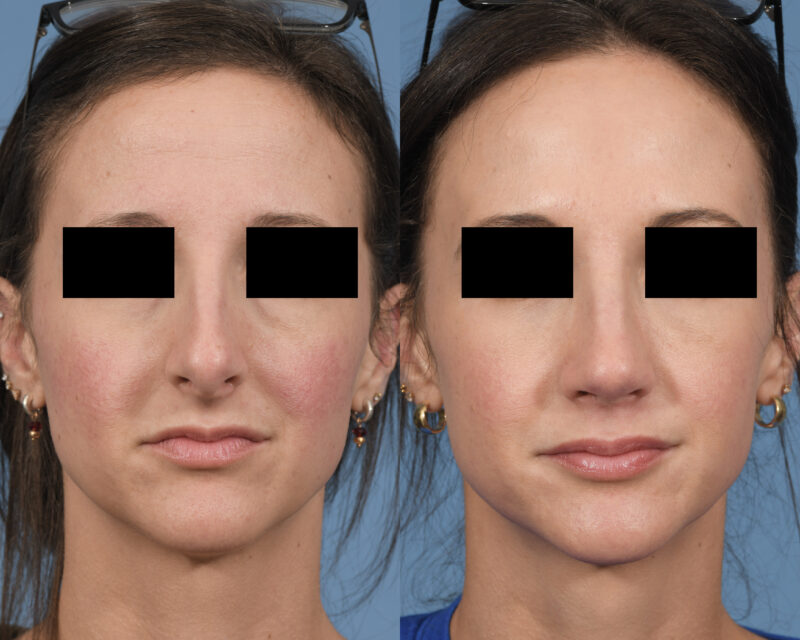
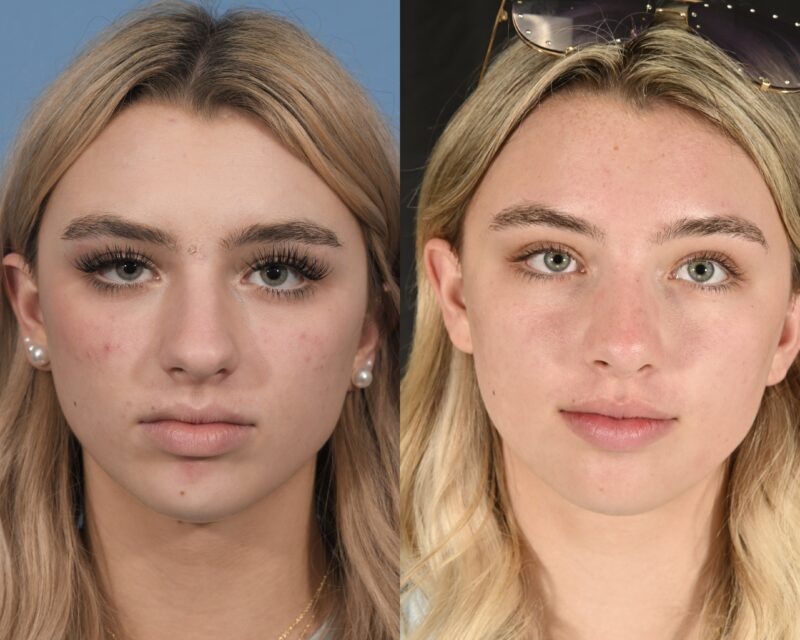
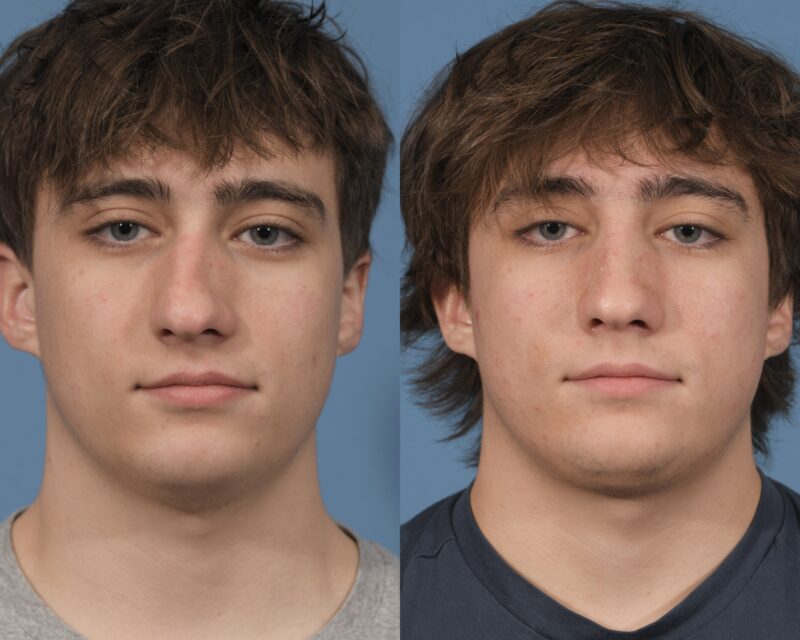
Rhinoplasty Before & After
Frequently Asked Questions
Look for double board-certification in Facial Plastic & Reconstructive Surgery and a portfolio of cases that resemble your own anatomy and goals. The first consultation should feel like a conversation, not a sales pitch.
Most patients describe the recovery as pressure and congestion rather than pain. Discomfort is well-controlled with oral medication for the first few days.
When performed by a board-certified surgeon in an accredited facility, rhinoplasty has an excellent safety record. Risks are reviewed thoroughly in the pre-operative visit.
A closed rhinoplasty leaves no visible scar. An open rhinoplasty adds a small columellar incision that heals to a fine line and is essentially invisible at conversational distance.
A male rhinoplasty respects the proportions and angles of the male face. Dr. Smith treats male and female rhinoplasty as distinct procedures.
The nose finishes growing around fifteen for girls and sixteen for boys. There is no upper age limit; candidacy depends on overall health.
Every rhinoplasty begins with a private, in-person consultation

Schedule a private
consultation
Two locations across the DFW area. All consultations are conducted personally by Dr. Smith.
Fort Worth, TX 76104
Colleyville, TX 76034